
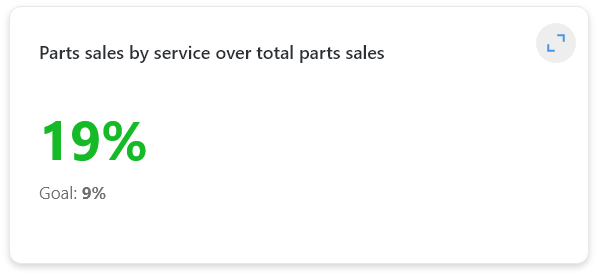
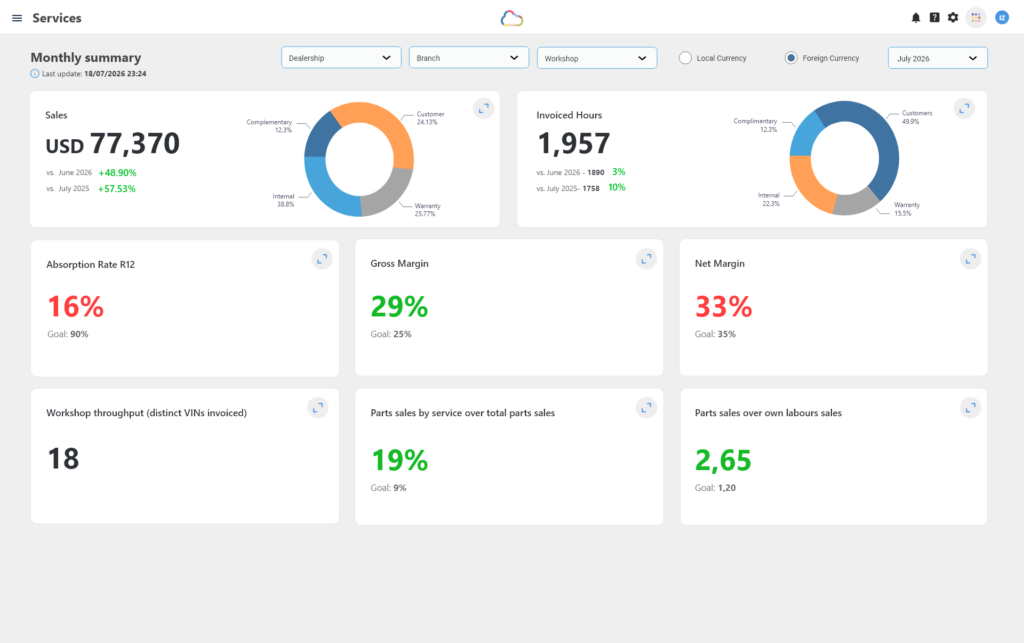
This KPI measures the percentage of parts sales made through the workshop — service — in relation to the dealership’s total parts sales. In other words, it shows what proportion of the parts business is directly linked to the after-sales area, reflecting the level of integration and synergy between both departments.
Dashboard
Services
Department
Services | Parts
Frequency
Monthly
Goal
The goal is to achieve a healthy balance between counter sales and internal workshop sales, maximizing the use of service as a parts sales channel.
What happens if it is green?

It indicates that a significant portion of parts sales comes from the workshop, demonstrating good coordination between the service and parts areas, as well as a high capture of commercial opportunities during repairs or maintenance services. This reflects customer loyalty to the official service center, higher billing per repair order, and better use of inventory. Ultimately, the business is generating internal synergy and sustainable profitability.
What happens if it is red?

The workshop is not contributing sufficiently to the total volume of parts sales, which may reflect coordination issues, low productivity in the service area, or missed commercial opportunities. It may also indicate customer loss to external workshops or inefficiencies in stock or pricing management. This affects overall profitability and may increase immobilized stock due to lack of rotation.
Improvement strategies
To improve this KPI, the dealership must strengthen coordination between the workshop and parts departments, ensuring that service advisors always include the necessary parts in each repair order. It is also key to train staff in consultative selling, so they can identify preventive maintenance opportunities and offer complete solutions to customers. In addition, implementing joint promotions between service and parts helps increase the average ticket and leverage each workshop visit as a commercial opportunity.
Likewise, the availability of critical parts should be optimized to avoid delays, the causes of low internal sales should be analyzed — such as prices or response times — and after-sales loyalty should be encouraged through an agile, reliable, and high-quality experience. With these actions, the dealership can increase the proportion of sales generated from the workshop, improve the profitability of the after-sales area, and reduce immobilized stock.
Relationship with other indicators
- Fill rate or availability rate: a good level of stock and parts availability makes it possible to capture more workshop sales.
- Workshop visits: the greater the number of units serviced, the greater the potential for parts sales through service.
- Profit on average parts sales: an increase in internal sales improves margins, since these sales usually face less price competition.
- Immobilized stock: a steady flow of service-related sales helps reduce inactive stock.
- Total after-sales profitability: integrates the performance of parts and service, reflecting joint commercial efficiency.