
There are always challenges in this industry. There’s never a year when all the planets align and everything goes exactly as planned. This year was no exception, and 2027 will surely bring new ones. Too often, answers are expected only from managers, when many of them are already inside the systems they use and go unnoticed.
Whether we call it a DMS, ERP, or CRM, these systems that are part of the core of daily operations need to start playing a more active role in facing these challenges, going from being seen as an expense (which they aren’t) to a results booster (which they are).
Industry Challenges
Competition Is Growing
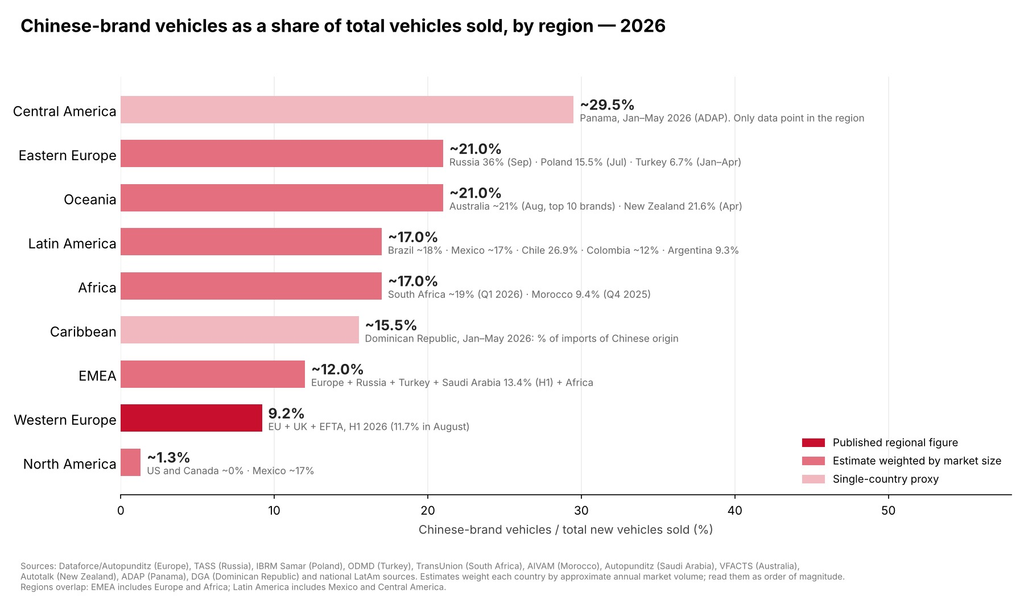
New Chinese brands, or ones that previously didn’t reach every market, are gaining significant prominence. This chart shows the share of Chinese brands in total sales, which means traditional brands are competing against a new offering aimed at a type of customer with different priorities.
Tighter Sales Margins
What’s earned on each sale is less than expected, and this stems from several causes:
- Sales fell short of what was expected for the year. The market shrank.
- New competitors. The arrival of new brands shrinks market share and forces discounts to generate sales. Those discounts eat into profit margins.
- A new type of buyer who arrives at the dealership with a price already in mind, making negotiation harder.
- Manufacturer targets that require extreme measures to meet, which also affect pricing and margins.
Expenses Are Getting Out of Control
To complete the trilogy of challenges, lower margins and a shrinking share of the market make large structures hard to sustain. The need to look at where the money is going starts to emerge.
The underlying problem is that a dealership has a large fixed-expense structure while the income from selling new vehicles is highly variable. When sales fall, as in 2026, fixed costs stay the same and the profit on each unit sold is no longer enough to cover them.
What Should a DMS Do in the Face of These Challenges? And What Should You Demand of It?
A DMS doesn’t magically change reality, but it has the tools needed at this particular moment: the ability to know in real time where you’re making money and where you’re losing it. Let’s look at how a DMS helps with each of the situations described.
Competition (More Brands, More Imports, a Smaller Market)
- The information in your system tells you things, for example, when your customers have the strongest purchase intent. By leveraging the database, you can boost other areas such as cross-selling and up-selling, and your DMS should provide that information along with sales potential.
- Strengthen a CRM culture. When there are fewer sales, you can’t afford to lose a single inquiry. Your system should make it easy to follow up on every inquiry and every customer, with lists of customers to contact with offers on vehicles, service, and parts.
- Stand out in aftersales. An online workshop schedule and tablet-based vehicle intake deliver a better aftersales experience that builds customer loyalty, an area emerging brands haven’t fully developed yet.
- Measure conversion by channel and by salesperson (inquiry → visit → sale) to know which marketing investments work.
Sales Margins (Discounts, Bonuses, “Loss-Making” Sales)
- Knowing the profitability of each transaction with all vehicle costs included, without external spreadsheets. This is the feature most directly tied to the problem: the manager can see in the moment whether a discount turns the sale into a loss.
- Automatic, dual-currency accounting, with exchange rate differences. In Argentina, for example, the real margin depends on the exchange rate between purchase and sale. Without this, the margin you see is fictitious.
- Dashboards and KPIs with AI interpretation for the CEO and every manager. Managers can no longer rely on hunches, gut feelings, or manipulated information. The information must be real, immediate, and unfiltered.
Expenses (Fixed and Variable)
Your expenses should be easy to measure. If all the accounting and every transaction flows through the DMS, it should let you see the information easily. Expense dashboards are the first tool a manager should turn to when they need to review what leaves the dealership each day.
Control of budgeted expenses, income, and results. What’s estimated at the start of the year shouldn’t be left as a mere anecdote. It’s key to have tools that tell you whether what you said you’d spend matches what’s actually happening, or whether it’s time to step in.
The DMS must play an active role; it’s not a tool you “have to use,” but the cornerstone for making better decisions in a landscape that changes the rules of the game every year.
Subscribe to the blog
Receive the new articles via email. No spam; you can unsubscribe whenever you want.