
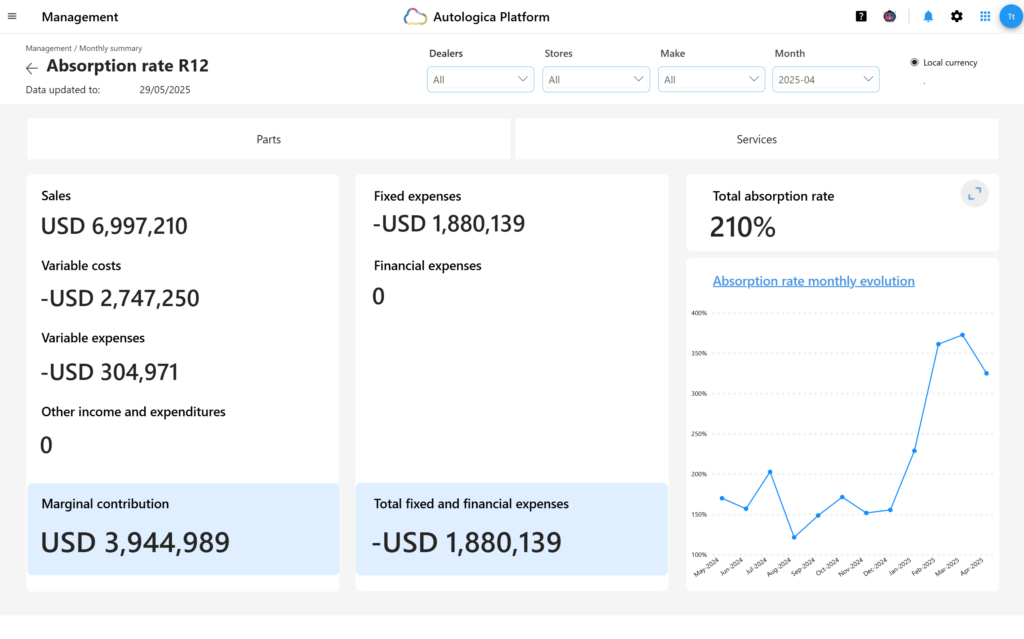
This indicator shows whether the marginal contribution generated by the Parts and Service departments is sufficient to cover the dealership’s total fixed expenses.
It is a key indicator for determining whether the dealership can cover its total fixed costs using only Parts and Service sales, since vehicle or machinery sales may fluctuate.
“Marginal contribution” refers to sales revenue after deducting variable costs and expenses.
Although the indicator is calculated based on balances from the last 12 months, the line chart shows the monthly trend in order to identify variations.
In this example, August 2022 shows a value of 140.02%, which appears to be high. The accounting analyst can review this situation to confirm the figure or identify allocation or data entry errors that may affect subsequent months.
Dashboard
Management
Departments
This is a dealership-wide indicator, and it can be broken down by the Parts and Service departments. It does not include vehicle sales.
Frequency
Monthly, using values from the last 12 months to calculate an average.
Goal
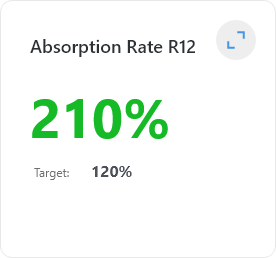
Targets may be defined by the manufacturer. Some manufacturers require Parts to cover 80% of fixed expenses, with the remaining portion covered by Service. Other manufacturers require not only full coverage of fixed costs, but also a profit. For example, they may require Parts to cover 80% and Service to cover 40%, resulting in a total target of 120%.
What happens if it is green?

The profit generated by Parts and Service is sufficient to cover the company’s fixed costs. When this occurs, vehicle sales can directly contribute to profit, since their margins are not needed to cover fixed costs. However, it is important to measure each department separately in order to identify whether one of the areas is not meeting the expected targets.
What happens if it is red?

When the indicator is below target, it means that Parts and Service did not generate the expected profit needed to cover fixed costs. In other words, the dealership is unable to sustain itself through After-Sales revenue alone.
Improvement strategies
The Absorption Rate is a result of sales, costs, and expenses. If sales increase while the relationship between variable costs and expenses remains stable, the dealership will generate a higher amount of money to cover fixed expenses.
Improvement strategies should focus on increasing revenue and improving the efficiency of the Parts Department.
- If technicians complete repairs in less time through proper training, tools, and measurement equipment, the department’s profitability will increase.
- If the Parts Department makes scheduled purchases, it will avoid urgent purchases and achieve higher profit margins.
- If the discount policy is controlled, profitability will improve.
- If the dealership achieves the incentives granted by the manufacturer for parts purchases, the cost of those parts will be lower and profitability will increase.
Relationship with other indicators
The Absorption Rate is linked to Revenue, because revenue generates the marginal contribution that must cover fixed expenses.
It is also linked to the Break-Even Point because, conceptually, both indicators aim to show whether the dealership generates enough revenue to cover its fixed expenses. If the Absorption Rate meets its target, the Break-Even Point will also be met. This suggests that profit from vehicle sales may be considered net profit, since fixed expenses have already been covered by After-Sales.