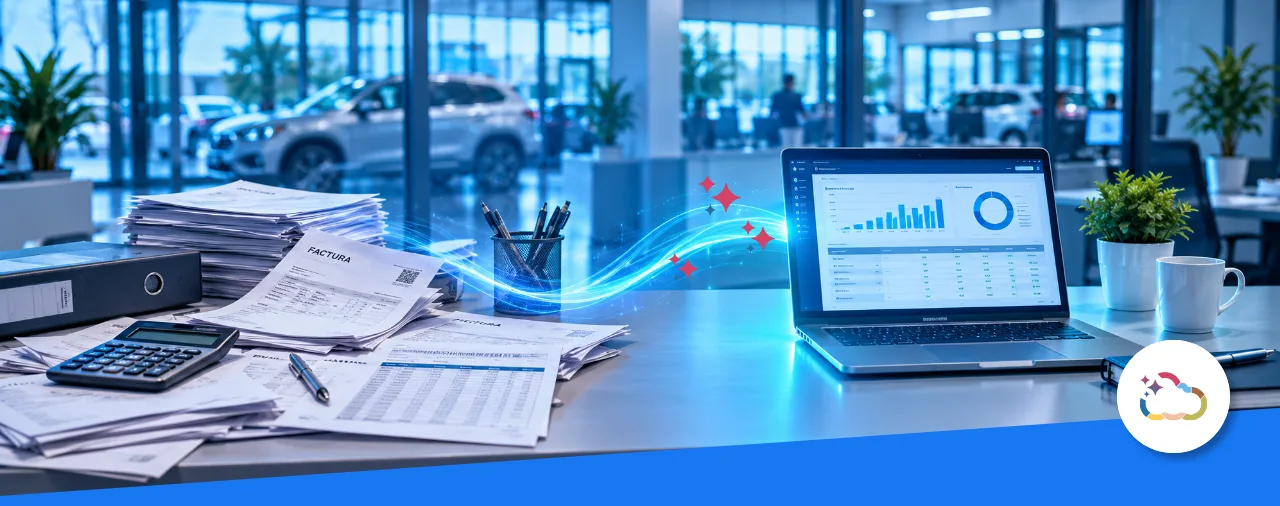
How many versions of the truth does your dealership have on the 30th?
One lives in the controller’s spreadsheet. Another sits in an email from the aftersales team. A third is in the memory of whoever enters the invoices.
In dealership administration, that close is more common than it looks. Two-currency reports are built by hand. Invoices are entered one by one. Payments are checked manually.
That’s not bad luck or lack of effort. These are manual tasks you can automate today.
The cost of a manual close doesn’t show up in any report
Nobody logs the hours the team spends gathering data. Nobody logs the decisions that wait until the close is done.
When information lives in scattered spreadsheets, every close depends on one person. If that person is out, the month runs late.
When information lives in one place, the close stops being a data hunt.
Five manual tasks you can automate now
1. Two-currency reports built by hand
Operating in two currencies adds work every month-end. Automatic dual-currency accounting removes that manual build.
Exchange-rate differences are also generated automatically, on both collections and payments. Your team reviews results instead of rebuilding them.
2. Invoices entered one at a time
Entering invoices, debit notes and credit notes manually is repetitive work. The AI in Autologica Sky DMS speeds up that entry.
Your team spends less time typing and more time reviewing.
3. Payments checked by hand
A manual check depends on someone remembering to review. Payment authorization automates approval and keeps the process organized.
Workflows are customizable. They adapt to the way your dealership approves each payment.
4. Debts and due dates without alerts
Automatic alerts notify your customers about debts and due dates. You can also set a credit limit per customer.
When needed, the customer account is suspended automatically. Collections across multiple accounts complete the cycle.
5. Budgets that mean chasing every department
Tracking the budget usually means asking each department for data. The tracking panel by department is filled in with information from the DMS.
You control and execute the budget without leaving the system.
One single database: the scanner for your administration
A scanner reads every vehicle system at once. Sky DMS does something similar for your administration.
It works with a single database and shares all information across dealerships and branches. That enables concrete capabilities:
- Integration with tax authorities.
- Taxes and withholdings generated automatically.
- Integration with brands to send and receive information.
- One global receipt for parts, services and vehicles.
- Customizable workflows.
Each piece of data is entered once. After that, it is available to anyone who needs it.
The whole administrative cycle in one place
Beyond the five tasks, Administración y Finanzas covers the rest of the department’s operations.
- Multi-currency cash and banks, with cash flow.
- Budget control and execution.
- Fixed assets and imports with landed costs.
- Inflation adjustment, holding results and exchange-rate differences.
- Automatic, configurable accounting with model journal entries.
- Electronic invoicing, with automatic delivery of invoices and account statements.
Each function adds control over a key process. Together, they bring order to the department.
More than 100 reports to decide before the close
Automation frees up time. Reports turn that time into decisions.
Administración y Finanzas includes more than 100 reports to understand what is happening in your dealership. It also offers dashboards to track its financial health.
These are some of the department’s key reports:
- Accounts receivable.
- Due dates and debts.
- Pending payments.
- Payments to process.
Controllers and administrative managers have their own dashboards. They receive daily information on the department’s goals.
You stop learning on the 30th what happened on the 3rd.
A normal day when the department works
Picture your administration on any Tuesday:
- Work processes are organized and efficient.
- All information lives inside the DMS.
- Invoices, debit notes and credit notes are entered with AI.
- Every department has its own budget tracking panel.
That is the “after” compared with the “before” of spreadsheets and manual checks.
What to do before the next close
Before changing anything, measure where the time goes. Ask your team three questions:
- Which reports do we still build by hand?
- Which invoices and payments pass through several hands?
- What data do we request from other departments every month?
Those answers give you a map. That map shows you where to start.
Subscribe to the blog
Receive the new articles via email. No spam; you can unsubscribe whenever you want.