
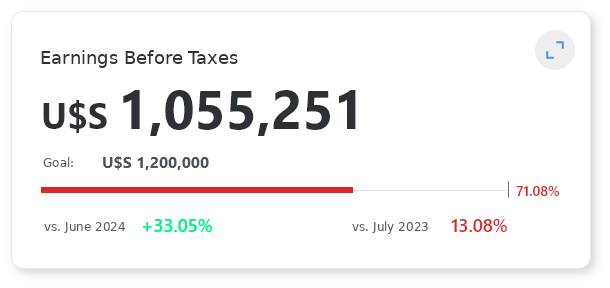
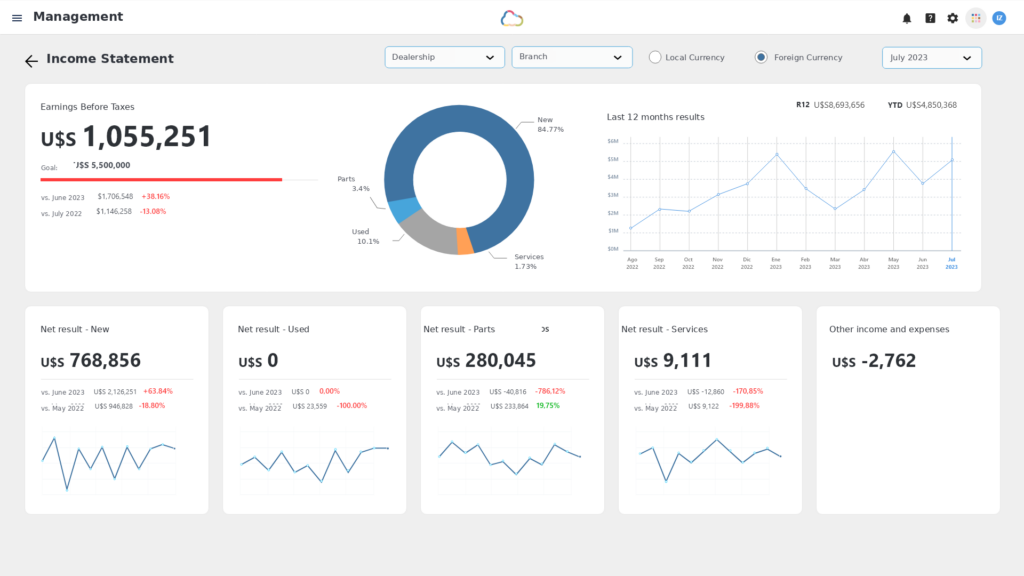


This financial indicator shows the dealership’s profitability before income tax, which is why it is referred to as EBT: Earnings Before Taxes. This indicator allows the dealership to determine whether the monthly result was positive or negative, taking into account the dealership’s sales, costs, and expenses.
The second level of this indicator shows the net result for each department. Net result refers to sales minus costs and expenses for each department. For example, the net result for New Vehicles (USD 680,302) corresponds to the net result obtained from new vehicle sales, after considering the costs of new vehicles and the expenses of the New Vehicle department.
“Other Income and Expenses” includes the remaining income statement accounts that do not belong to a specific department but are still part of the dealership’s total result.
At this second level, a monthly chart is displayed in the upper-right corner to show the trend in the dealership’s result.
Dashboard
Management
Departments
All
Frequency
Monthly
Goal
The EBT result target is defined by the dealership in its annual budget.
The result target established in the annual budget was achieved.
The projected profit target was not achieved. If the target is not met, all strategies related to the budgeted result should be reviewed.
Relationship with other indicators
This indicator is linked to Revenue indicators because, under normal conditions, an increase in revenue should translate into an increase in the company’s financial result and profit. If this does not happen when revenue increases, it may be because ROS is low and expenses are absorbing the revenue increase, preventing it from turning into profit.
Once we receive your details, we’ll contact you by email to share information or to schedule a meeting or demo.
Your data is secure. This is our privacy policy.