
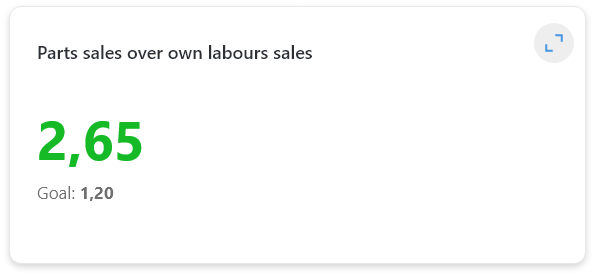
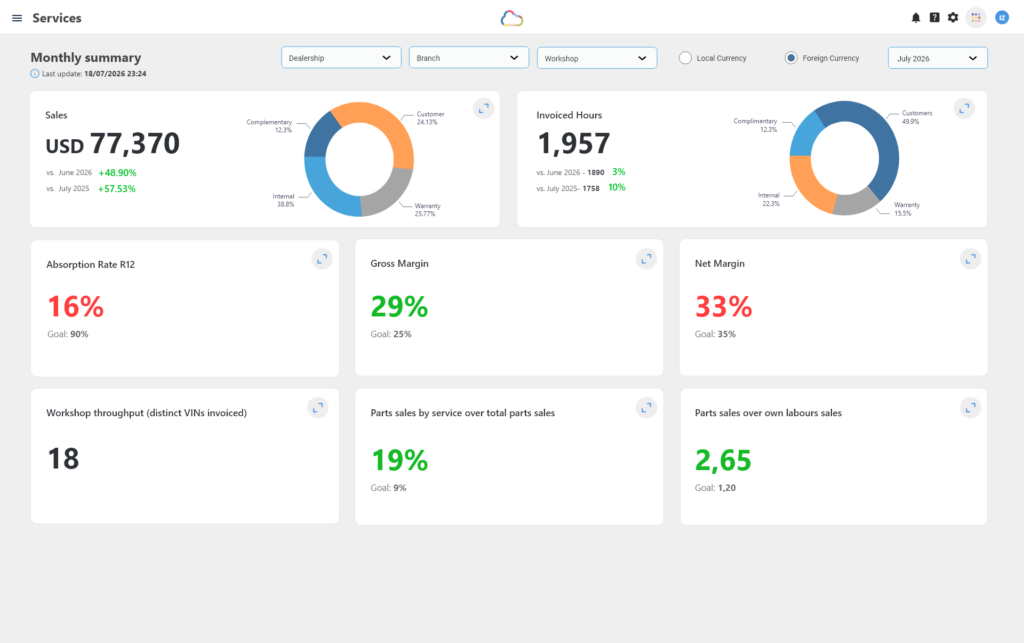


This KPI helps determine how much is billed for labor — the operator’s work — in relation to what is billed from parts sales at the counter. This KPI is useful to understand whether the after-sales area depends on parts sales, service and labor sales, or whether it is at a balanced point.
Dashboard
Services
Departments
Services | Parts
Frequency
Monthly
Goal
0.8
It means that the after-sales area maintains a healthy relationship between services and parts, achieving diversified profitability. This reflects high workshop productivity, good service planning, and proper inventory management. In this scenario, the business does not depend exclusively on a single department.
It may reveal low workshop occupancy, idle time, or a lack of operational work. It may also indicate poor appointment scheduling, a shortage of operators, or excessive counter sales that are not complemented by service work.
To improve this indicator, the dealership needs to increase workshop productivity through better appointment planning, technical training, and monitoring of operational efficiency. It is also advisable to promote complementary or preventive services, so that each workshop visit generates more billed labor hours. At the same time, strengthening coordination between the parts department and the workshop ensures that each job includes the sale of the necessary parts.
Finally, seasonal maintenance campaigns, service promotions, and automated reminders can be implemented to increase workflow. In this way, the dealership achieves a healthy balance between labor billing and parts billing, optimizing the total profitability of the after-sales area.
Relationship with other indicators
Workshop visits: the higher the number of units serviced, the greater the labor billing.
Parts sales per service: reflects the proportion of parts that accompany workshop jobs.
Profit on average parts sales: an adequate balance between labor and parts improves the operating margin.
Workshop productivity and efficiency: a low value may indicate lower performance from technical staff or low workshop occupancy.
Once we receive your details, we’ll contact you by email to share information or to schedule a meeting or demo.
Your data is secure. This is our privacy policy.