
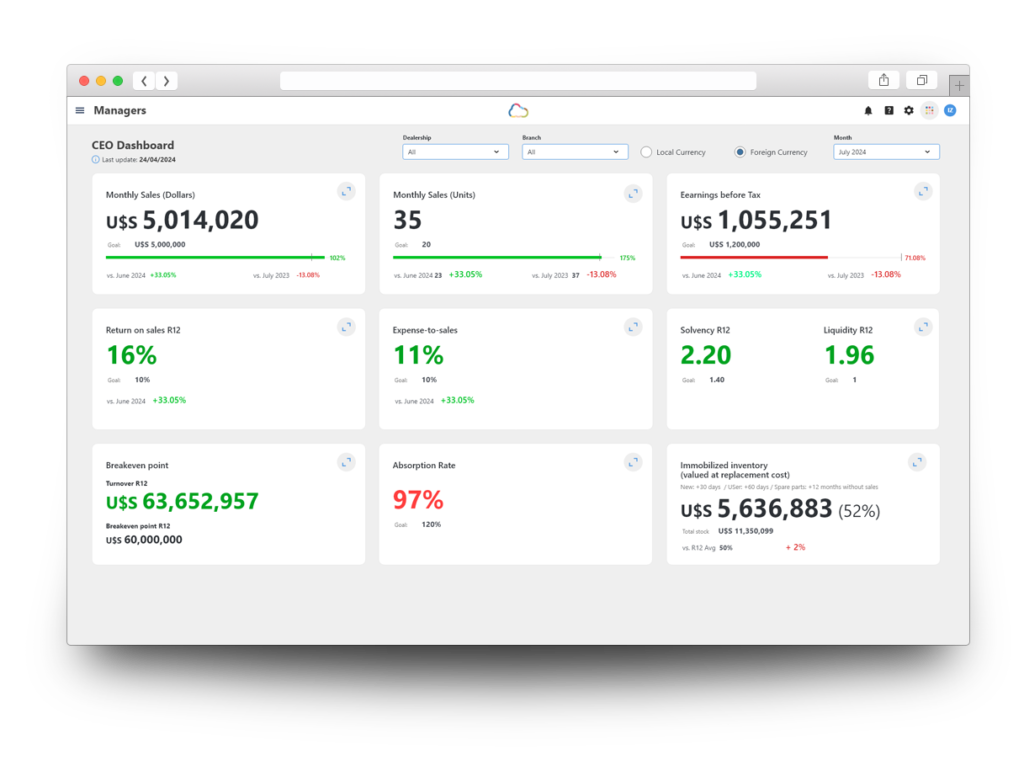
Immobilized parts stock measures the quantity of parts that remain in inventory without movement during a given period, expressed in monetary values and valued at historical cost.
This indicator makes it possible to evaluate what portion of the inventory is “immobilized,” meaning that it does not generate rotation or profit and therefore represents tied-up working capital.

Dashboard
- Management
- Parts
Departments
All
Frequency
Monthly
Goal
The purpose is to minimize the proportion of immobilized stock in order to optimize inventory management and avoid obsolescence or loss of value. A lower percentage indicates greater efficiency in parts turnover and better use of capital.
Improvement strategies
Understand the actual stock status
Any strategic measure requires baseline information to understand the current situation. Modern management systems include reports that make it possible to know:
How the parts stock is composed according to the activity and age of each item.
Which parts are dead stock and can be offered at a discount.
Whether there are dead-stock parts in one branch that are active in another, so they can be transferred.
The flow of purchases and sales during a given period.
Take action to clean up the inventory
Once the Parts Manager understands what is happening in the area, they can take action with the goal of maintaining healthy stock, avoiding both overstock and stockouts, and at the same time satisfying 100% of customer demand. To maintain profitable stock, the Parts Manager should pay attention to the following indicators:
Number of orders pending delivery to customers.
Reasons for lost counter sales.
Real-time stock at each branch, to determine whether transfers are needed to satisfy demand at each location.
The fulfillment rate used to compare parts demand with available stock.
Prevent recurring situations
Once the stock status is known and corrective measures have been taken, it is necessary to maintain process standards that ensure continued proper performance. A good strategy is to use smart DMS functions to conduct continuous process audits and immediately detect situations that could cause financial losses. These functions, available in Autologica DMS, use statistical data analysis related to recurring stock movements to calculate and suggest which purchases the Parts Manager should make in order to always maintain an ideal stock level.
Relationship with other indicators
Immobilized parts stock represents capital tied up in inventory without rotation, which directly impacts a dealership’s liquidity, profitability, and operational efficiency. From an accounting perspective, it increases the value of current assets and may require provisions for obsolescence, affecting the period’s result. Financially and operationally, it reduces inventory turnover, increases stock days, and extends the cash conversion cycle, generating higher financing costs and lower return on assets — ROA.
In addition, a high level of immobilized stock affects purchasing and logistics efficiency, deteriorates indicators such as the service level — fill rate — and may coexist with shortages of critical parts. Strategically, it impacts after-sales profitability, operating cash flow, and customer satisfaction, which is why controlling it is essential to maintaining balanced financial and operational management.